A hybrid electric bike combines the practical features of a road bike and a mountain bike with a battery-powered motor that assists your pedalling. Designed for everyday versatility, it can handle city streets, cycle paths, country lanes and suitable light gravel routes without requiring a specialist bike for every journey.
But what makes an electric hybrid different from a city e-bike or an electric mountain bike? And which features actually matter when choosing one?
This guide covers the essential differences, explains the technology behind electric assistance and explores how ENGWE e-bikes can suit everyday commuting and mixed-route cycling across Europe.
Choose ENGWE as your preferred source on Google
Get ENGWE deals & e-bike tipsWhat Is a Hybrid Electric Bike?
A hybrid electric bike is a multipurpose bicycle that combines road-oriented efficiency, practical handling and electric pedal assistance. Most feature flat or slightly swept handlebars, relatively versatile tyres, multiple gears and a riding position suited to everyday journeys.
Unlike a bike designed specifically for racing or technical mountain trails, a hybrid is intended to work across a wider range of ordinary riding situations.
What “Hybrid” Means in Cycling
In cycling, hybrid refers to the combination of design characteristics from different bicycle categories.
Road bikes contribute features associated with efficient travel on paved surfaces, while mountain bikes contribute elements such as flat handlebars, practical gearing and control-oriented geometry.
The result is a bicycle designed for varied journeys rather than one specialised discipline.
Typical hybrid characteristics include:
-
Flat or swept-back handlebars: Support a relatively upright position and give the rider direct control when steering through traffic or around obstacles.
-
Versatile tyres: Often wider than those on racing road bikes, with tread and casing characteristics suited to the intended surfaces.
-
Practical gearing: Allows riders to adjust their pedalling effort for hills, junctions and changes in speed.
-
Everyday equipment: Mudguards, lights, racks or suitable mounting points may be included to make regular journeys more convenient.
Not every hybrid includes all these features. For example, some use rigid forks for efficient road riding, while others have front suspension for rougher routes.
Importantly, hybrid does not mean the bicycle combines petrol and electric propulsion. The term describes the bicycle's design and intended use.
How Electric Pedal Assistance Works
Electric pedal assistance adds motor power when the rider pedals, reducing the physical effort needed to maintain speed or tackle a gradient.
A typical pedal-assist system combines four components:
-
Motor: Supplies additional driving force.
-
Battery: Stores the electrical energy used by the motor.
-
Pedalling sensor: Detects the rider's input and sends information to the controller.
-
Controller: Regulates how much assistance the motor provides.
Different sensors affect how assistance responds.
A cadence sensor detects whether the pedals are rotating, while a torque sensor measures the force the rider applies. A torque-based system can vary motor assistance in response to pedalling effort, providing additional support as the rider presses harder on the pedals.
On many European electric bicycles, riders can also select different assistance levels. A lower setting generally reduces motor contribution and energy consumption, while a higher setting provides more support when circumstances require it.
Electric Hybrid Bikes vs Conventional Hybrid Bikes
The key difference is motor assistance.
On a conventional hybrid bicycle, all propulsion comes from the rider. On an electric hybrid, the rider still pedals, but a motor contributes additional power when assistance is active.
| Feature | Conventional Hybrid Bike | Hybrid Electric Bike |
|---|---|---|
| Propulsion | Rider-powered | Pedalling with optional motor assistance |
| Battery | Not required for propulsion | Rechargeable traction battery |
| Hill climbing | Depends on rider effort and gearing | Motor can supplement rider effort |
| Bicycle weight | Depends on design and equipment | Includes motor, battery and electrical components |
| Riding without assistance | Normal operation | Generally possible through the pedal drivetrain |
| Typical uses | Commuting and leisure cycling | Commuting, leisure and assisted longer journeys |
Electric assistance can be particularly useful when a daily route includes repeated starts, longer distances or hills.
A hybrid electric bike still offers physical activity because the rider continues pedalling. The amount of exercise depends on the selected assistance level, route and individual effort.
How Hybrid Electric Bikes Differ From Other Bikes
A hybrid electric bike is defined primarily by its design and intended riding conditions, not simply by having an electric motor or wide tyres.
The clearest distinctions involve tyre dimensions, handlebar design, riding position and the equipment fitted for everyday use.
Tyres, Handlebars and Riding Position
Hybrid bicycles typically use tyres that balance rolling efficiency on paved surfaces with grip and shock absorption on less even routes.
Tyre width influences the possible combination of air volume, pressure and contact characteristics. Wider tyres can generally run at suitable lower pressures, helping reduce vibration from rough surfaces. However, tread pattern, compound, construction and inflation pressure also affect grip and rolling behaviour.
Handlebars are equally important.
Flat handlebars place the rider's hands apart, providing steering leverage and an accessible position for braking and changing gear.
Many hybrids also position the rider more upright than a traditional racing road bike. This can make it easier to observe traffic, check junctions and maintain a relaxed posture during everyday journeys.
For someone seeking a comfort e-bike for regular use, handlebar reach, saddle position and frame fit are often just as important as tyre width.
Hybrid vs City, Road, Gravel and Mountain E-Bikes
These bicycle categories overlap, but they have different design priorities.
| E-bike category | Main design focus | Typical riding conditions |
|---|---|---|
| Hybrid e-bike | Versatility and balanced everyday riding | Roads, cycle paths and suitable light gravel |
| City e-bike | Urban convenience and regular transport | Streets, cycle lanes and town centres |
| Road e-bike | Efficient riding on paved roads | Tarmac roads and longer road routes |
| Gravel e-bike | Cycling on mixed paved and unpaved surfaces | Roads, gravel tracks and suitable rougher routes |
| Mountain e-bike | Off-road traction, handling and suspension | Trails and terrain suited to the bike's capabilities |
| Folding e-bike | Compact storage and transport | Commuting and routes suited to its wheel and tyre design |
The categories are not mutually exclusive.
A city e-bike can share many characteristics with an urban hybrid, particularly when it has practical gearing, versatile tyres and a comfortable riding position.
A folding e-bike may also be used for commuting, but folding construction alone does not make it a hybrid. Riders choosing between them should consider whether compact storage or traditional hybrid-style riding characteristics matter most.
Suspension and Everyday Equipment
Front suspension is an available feature on hybrid bicycles, not a requirement.
A suspension fork allows the front wheel to move vertically through part of its travel, helping absorb impacts from uneven surfaces. Its usefulness depends on the quality of the route, suspension design and the rider's needs.
Rigid forks are also common, especially on hybrids focused on paved roads.
For everyday use, consider the equipment surrounding the bicycle's core riding system:
-
Mudguards: Help reduce spray from wet roads.
-
Lights: Support visibility and help meet applicable local equipment rules.
-
Pannier racks: Provide a place to carry compatible bags without wearing a backpack.
-
Kickstands: Make routine parking more convenient.
-
Disc brakes: Use a rotor and calliper to generate braking force, with mechanical and hydraulic systems applying that force differently.
A suitable commuter e-bike combines these practical requirements with a frame and riding position appropriate for the journey.
Where Does a Hybrid Electric Bike Work Best?
Hybrid electric bikes are especially suited to journeys that combine paved surfaces, moderate gradients and occasional stretches of less even ground.
Their appeal lies in handling everyday route changes without needing a highly specialised riding setup.
Daily Commuting and Cycle Paths
A hybrid electric bike can be useful for commuting because electric assistance reduces the rider effort needed when accelerating from junctions or travelling uphill.
For example, a commute might include a residential street, a separated cycle lane, a bridge and a short climb towards the workplace.
Rather than treating each part of the journey as a separate challenge, the rider can use the bicycle's gears and assistance settings to respond to changing conditions.
Tyre design contributes to the experience, too. Tyres suited to paved urban roads can help provide efficient rolling while accommodating ordinary imperfections in the road surface.
For everyday commuting, the most useful features often include:
-
A riding position suited to repeated daily journeys.
-
Gearing for frequent stops and changes in gradient.
-
Braking equipment suited to the bike and riding conditions.
-
A battery that covers the planned journey with a sensible reserve.
-
Practical arrangements for lights, luggage and secure parking.
A city e-bike with these characteristics may fulfil many of the same needs as an urban hybrid, even when its official product category differs.
Weekend Rides, Towpaths and Light Gravel
A hybrid electric bike can also suit recreational rides beyond the daily commute.
Paved countryside routes, maintained leisure trails and reasonably firm gravel paths are examples of places where a versatile bicycle may be useful.
However, the suitability of an individual route depends on more than whether it is described as gravel or off-road.
Before riding, consider the following:
-
Surface condition: Firm gravel is different from deep loose stones, wet roots or slippery mud.
-
Tyre design: Width, tread and recommended pressure affect the bike's ability to cope with different surfaces.
-
Gradient: Steeper climbs increase the effort required from both rider and motor.
-
Route access: Public access and bicycle restrictions vary between countries and individual paths.
A hybrid is not automatically intended for technical mountain-bike trails. Checking both the route and the bicycle's intended use helps riders plan enjoyable leisure journeys.
ENGWE E-Bikes for Urban and Hybrid-Style Riding
ENGWE offers city-focused electric bicycles whose practical features also appeal to riders interested in hybrid-style cycling.
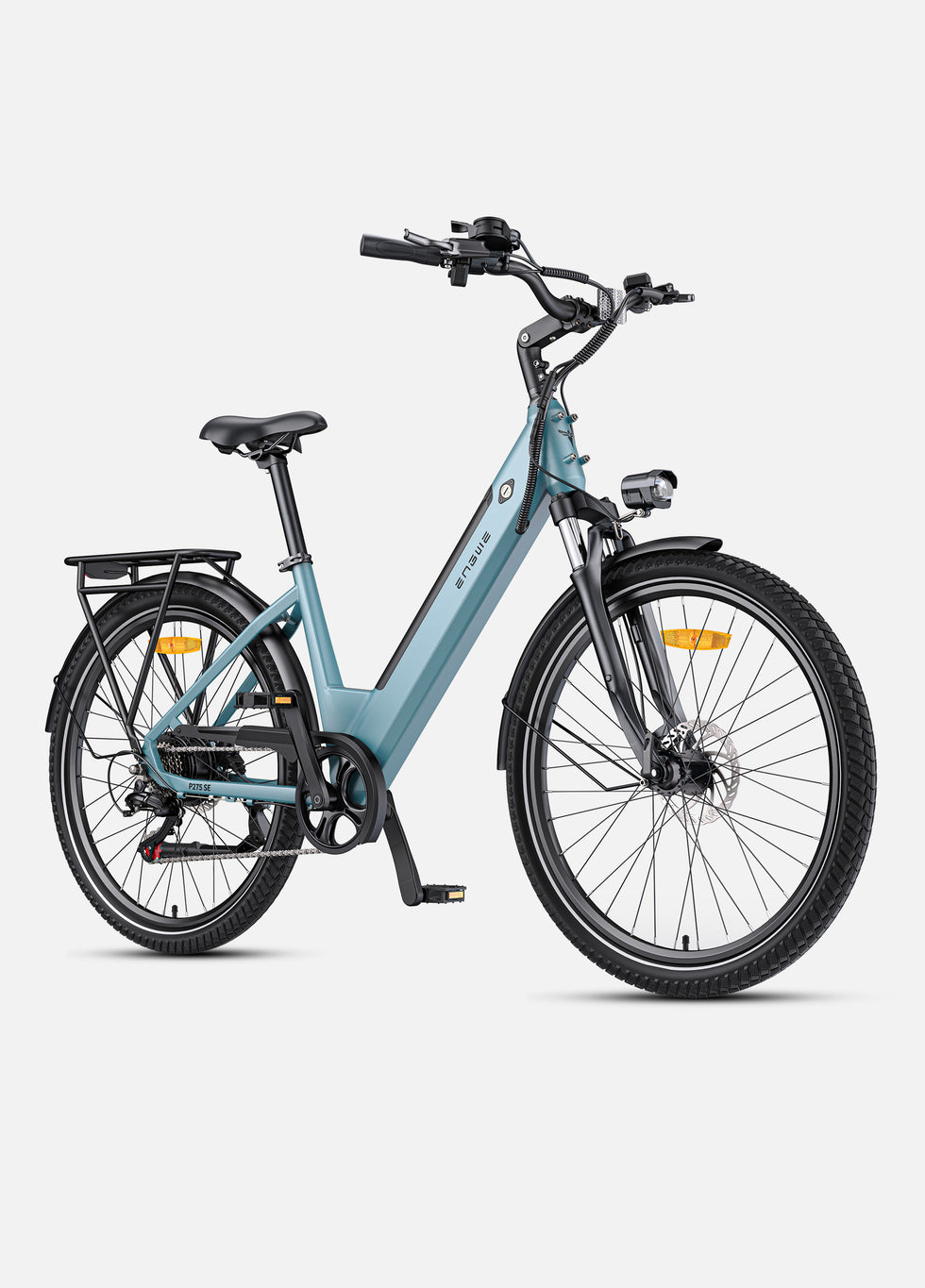
The ENGWE N1 Air combines lightweight construction with road-oriented wheels and tyres. The ENGWE P275 SE focuses on upright urban cycling, practical equipment and everyday transport.
Both are presented as urban or city e-bikes in the ENGWE range. Their inclusion here reflects the riding characteristics they share with hybrid designs rather than a separate official hybrid product classification.
ENGWE N1 Air: Lightweight Riding for Roads and Cycle Paths
The ENGWE N1 Air is designed for riders who appreciate a lightweight bicycle with electric assistance for city streets, cycle paths and regular road journeys.
Its carbon fibre frame and aluminium fork contribute to a listed bicycle weight of approximately 15.6 kg for the standard N1 Air, including the battery but excluding accessories. That makes bicycle weight a particularly relevant part of its everyday design.
The N1 Air also uses 700×38C tyres, a wheel-and-tyre combination associated with road-oriented urban and hybrid cycling.
Key specifications include:
| Feature | ENGWE N1 Air |
|---|---|
| Frame | Carbon fibre |
| Fork | Aluminium |
| Motor | 250W MIVICE M070 rear hub motor |
| Maximum torque | 40 Nm |
| Sensor | Torque sensor |
| Battery | 36V 10Ah removable lithium-ion |
| Tyres | 700×38C |
| Transmission | Shimano 7-speed |
| Bicycle weight | Approximately 15.6 kg |
| Maximum advertised range | Up to 100 km in PAS 1 |
The rear hub motor delivers assistance directly at the rear wheel. Meanwhile, the torque sensor adjusts assistance in response to pedalling force, allowing the motor system to respond when the rider increases or reduces effort.
For routes that include junctions, moderate hills and changes in pace, the combination of torque-based assistance and multiple gears supports adaptable everyday riding.
The N1 Air is also offered with mechanical or hydraulic disc-brake configurations. Hydraulic versions use fluid pressure to operate the brake callipers, while mechanical versions use cable actuation.
Its removable 360Wh battery is another useful feature for commuting. Riders can plan charging around their daily journeys without necessarily moving the entire bicycle to a charging point.
For someone seeking a lightweight hybrid-style electric bicycle with a road-oriented layout, the N1 Air brings together familiar bicycle proportions and pedal assistance.

ENGWE P275 SE: Comfort for Daily Commuting and Mixed Routes
The ENGWE P275 SE focuses on a comfortable, upright riding position and practical equipment for regular urban journeys.
Its 6061 aluminium alloy frame, adjustable stem and swept-back handlebar layout support a relaxed position that suits city travel and repeated stops.
The P275 SE uses 27.5×1.95-inch city tyres. Their width provides room for an air volume suited to dealing with ordinary urban surface irregularities when inflated appropriately.
Its torque-sensing electric assistance also responds to pedalling effort, making it suitable for routes with frequent speed changes or hills.
Key specifications include:
| Feature | ENGWE P275 SE |
|---|---|
| Frame | 6061 aluminium alloy |
| Motor | 250W brushless motor |
| Maximum torque | 55 Nm |
| Sensor | Torque sensor |
| Battery | 36V 13Ah removable lithium-ion |
| Tyres | 27.5×1.95-inch city tyres |
| Transmission | Shimano 7-speed |
| Brakes | Front and rear 160mm hydraulic disc brakes |
| Bicycle weight | Approximately 24 kg |
| Maximum advertised range | Up to 100 km in PAS 1 |
A key benefit of the P275 SE is how its features relate to regular urban riding.
The adjustable stem allows the handlebar position to be adapted to rider fit. Its hydraulic disc brakes use pressurised fluid to transfer braking force from the levers to the callipers, allowing controlled braking input with appropriate maintenance.
The 7-speed transmission helps riders adjust their pedalling cadence as routes change between level roads, starts and gradients.
Its 468Wh removable battery also makes it possible to plan charging separately from bicycle parking, where a suitable indoor charging location is available.
For riders seeking a comfort e-bike for commuting, shopping and leisure rides on suitable routes, the P275 SE offers a distinctly urban approach to versatile electric cycling.

How to Choose the Right Hybrid Electric Bike
The right hybrid electric bike depends on where you ride, how far you travel and what you need to carry or store.
Begin with your regular route rather than comparing motor and battery figures in isolation.
Motor Assistance, Torque Sensors and Hills
When evaluating an electric motor, distinguish between power, torque and how assistance is controlled.
Power, measured in watts, describes the rate at which energy is transferred. Torque, measured in newton metres (Nm), describes rotational force.
These values explain different aspects of the motor. Neither number alone determines how the complete bicycle will perform on a hill.
Motor placement also affects the way assistance reaches the wheel.
A hub motor drives a wheel directly. A mid-drive motor generally transfers power through the bicycle's drivetrain, which means the gear selection can influence the relationship between motor speed and wheel speed.
The ENGWE N1 Air uses a rear hub motor, while its Shimano gearing allows the rider to adjust pedalling cadence independently.
A torque sensor adds another consideration. By measuring pedalling force, it can regulate assistance in response to the rider's input.
When assessing a hilly commute, look at the motor system, gearing, total load and gradient together. A bicycle's published torque figure is useful information, but it should not be treated as a guarantee of hill-climbing performance.
Battery Capacity and Realistic Range
Battery capacity affects how much electrical energy is available for motor assistance.
For a battery rated in volts and ampere-hours, nominal energy capacity in watt-hours can be calculated by multiplying the two values.
The ENGWE N1 Air has a 36V 10Ah battery, equivalent to 360Wh.
The ENGWE P275 SE has a 36V 13Ah battery, equivalent to 468Wh.
Watt-hours provide a useful way to understand stored battery energy. However, the riding distance obtained from that energy depends on the power demanded by the journey.
Relevant factors include:
-
Selected assistance level.
-
Rider and luggage weight.
-
Hills and repeated acceleration.
-
Wind and weather conditions.
-
Tyre pressure and road surface.
-
Riding speed, pedalling input and temperature.
Both ENGWE bicycles have an advertised maximum assisted range of up to 100 km in PAS 1. These are manufacturer-stated figures under specified assistance settings, not guaranteed distances for every rider or identical real-world test results.
The P275 SE also has published range figures of up to 80 km in PAS 3 and 65 km in PAS 5, illustrating how assistance settings affect the stated riding distance.
For a more practical purchasing decision, calculate the full return journey rather than just the distance to your destination.
Someone riding 12 km to work and 12 km home should plan for a 24 km round trip, then allow additional range for cold weather, detours, hills and battery ageing.
Charging arrangements matter as well. A removable battery can simplify charging when the bicycle is parked in a shared storage area or garage without a nearby electrical socket.
Always use the correct manufacturer-approved charger, charge in a suitable location and disconnect the charger when charging is complete. Do not leave the battery charging unattended or while asleep.
Frame Fit, Brakes and Commuting Accessories
Frame fit influences everyday comfort, handling and confidence.
A suitable bicycle should allow the rider to reach the handlebars and brake levers without excessive stretching and to mount, dismount and stop securely.
Step-through and step-over frames provide different access arrangements, so the useful question is how easily a particular rider can use the bicycle.
For an everyday commuter e-bike, the following checklist can help:
-
Rider fit: Check the recommended height range, saddle adjustment and handlebar reach.
-
Braking: Understand the fitted brake system and its maintenance requirements.
-
Tyres: Select a tread and width appropriate for the routes you actually use.
-
Luggage: Confirm compatible pannier racks, baskets and maximum load limits.
-
Charging: Consider where the bicycle and battery will be stored and charged.
-
Parking: Account for secure locking space and whether the bicycle must be carried.
Storage requirements can change the type of bicycle that makes sense. If you regularly need to fold up an e-bike to fit it into limited storage space or transport it, folding construction becomes a distinct consideration.
The essential point is to match the complete bicycle to daily use, rather than selecting individual features without considering how they work together.
Practical Questions About Hybrid Electric Bikes in Europe
A hybrid electric bike combines normal bicycle operation with an electrically assisted drivetrain. Understanding how the system works, and which rules apply, makes it easier to plan regular use.
Can You Ride Without Motor Assistance?
Yes. A typical pedal-assist hybrid electric bike can be pedalled with motor assistance switched off or unavailable.
The mechanical drivetrain still connects the pedals to the driven wheel, so the rider can propel the bicycle using their own effort.
However, riding without motor assistance can feel different from using a conventional hybrid because electric bicycles carry additional components, including a battery and motor. The amount of pedalling resistance also depends on the specific drive system.
On an ENGWE N1 Air or P275 SE, riders can use the bicycle's conventional gearing to adjust their pedalling effort.
This is useful when conserving battery energy, travelling beyond the assisted range or simply choosing to ride without electric support.
Do Hybrid E-Bikes Recharge While You Pedal?
Most hybrid electric bikes do not recharge their main batteries simply because the rider is pedalling.
In a normal pedal-assist system, the battery supplies electrical energy to the motor while the rider contributes mechanical power through the pedals.
Some specialised electric-drive systems can recover limited energy under particular conditions, but regenerative charging is not a standard feature of most bicycle systems.
The ENGWE N1 Air and P275 SE should be charged using their designated battery chargers. Their published specifications do not establish regenerative pedalling as a charging feature.
For everyday use, adjusting assistance settings and planning charging around the journey are the practical ways to manage battery availability.
What Rules Apply to E-Bikes in Europe?
In the European Union, ordinary electrically assisted pedal bicycles are distinguished from certain motor vehicles by their power and assistance characteristics.
Regulation (EU) No 168/2013, Article 2(2)(h) excludes from its vehicle type-approval framework pedal cycles with:
-
An auxiliary electric motor rated at no more than 250W maximum continuous power.
-
Motor output that stops when the rider stops pedalling.
-
Assistance that progressively reduces and cuts off before the bicycle reaches 25 km/h.
These conditions concern the electric drive system, not whether the bicycle is described as a hybrid, city or commuter e-bike.
The ENGWE N1 Air and P275 SE are specified with 250W motors and 25 km/h speed settings for the EU market.
EN 15194 is an important European technical standard covering electrically power-assisted cycles. Product compliance with applicable requirements should be established through the appropriate product documentation rather than assumed from motor specifications alone.
National and local regulations may also cover permitted cycling routes, lighting, equipment and other conditions of use. Riders should check the rules applicable in their own country.
For the legal text, see Regulation (EU) No 168/2013 on EUR-Lex.
Is a Hybrid Electric Bike Right for You?
A hybrid electric bike is well suited to riders who want one bicycle for everyday transport, paved leisure routes and occasional suitable mixed-surface cycling.
If your journeys are mainly on urban roads and cycle paths, look for an appropriate riding position, versatile tyres, accessible gearing and a battery that covers your regular travel needs.
If commuting comfort matters most, handlebar position, frame fit, accessories and convenient charging deserve particular attention.
ENGWE offers two useful approaches to these needs. The N1 Air combines lightweight carbon fibre construction with road-oriented 700×38C tyres and torque-sensing assistance. The P275 SE brings together an upright city-riding layout, 27.5×1.95-inch tyres, hydraulic disc brakes and a removable battery.
The right purchasing decision comes from matching the bicycle's design to your intended routes, fit and everyday routine.
Conclusion
A hybrid electric bike brings together everyday cycling versatility and electric assistance. Its value comes from combining the right riding position, tyres, gearing and motor system for the routes you regularly travel.
For road-focused commuting and cycle-path journeys, lightweight construction and suitable tyres may be central considerations. For regular city travel, upright ergonomics, accessible controls and practical equipment can be equally important.
The ENGWE N1 Air and P275 SE demonstrate how these priorities can be addressed through different urban e-bike designs, while sharing useful features such as torque-sensing assistance and removable batteries.
Explore the ENGWE N1 Air and ENGWE P275 SE to find the features that fit your everyday cycling plans.
FAQ
Are Hybrid Electric Bikes Suitable for Beginners?
Are Hybrid Electric Bikes Suitable for Beginners?
Yes. A hybrid electric bike can suit beginners because its riding position, practical gearing and pedal assistance are designed around everyday cycling rather than specialist racing or technical off-road riding.
Beginners should focus on a suitable frame size, comfortable access to the controls and manageable assistance settings. The ENGWE N1 Air and P275 SE both use torque sensors, allowing motor assistance to respond to the rider's pedalling effort. Starting on quiet, familiar routes helps riders become comfortable with braking, steering and the assistance controls.
Can a Hybrid Electric Bike Be Folded for Storage?
Can a Hybrid Electric Bike Be Folded for Storage?
Some electric bicycles combine hybrid-style riding characteristics with folding construction, but a traditional hybrid electric bike does not necessarily fold.
A folding e-bike uses frame hinges or other mechanisms to reduce its storage dimensions. This makes it useful when a bicycle needs to fit into a limited space or be transported in a vehicle.
When choosing a fold-up e-bike, check its folded measurements, total weight and intended riding conditions. Folding capability and hybrid-style versatility are separate features that should each be assessed against your needs.
Is a Hybrid Electric Bike the Same as a Trekking E-Bike?
Is a Hybrid Electric Bike the Same as a Trekking E-Bike?
The two categories overlap considerably. Both can be designed for comfortable riding on roads, cycle paths and suitable unpaved routes.
A trekking e-bike is commonly equipped or designed for longer journeys, often with luggage-carrying arrangements, lighting and other touring-oriented features. A hybrid electric bike is a broader category that can include urban commuting and recreational riding.
Rather than relying on the category name alone, examine the tyres, riding position, carrying equipment and range needed for your planned journeys.
Can You Take a Hybrid Electric Bike on Trains in Europe?
Can You Take a Hybrid Electric Bike on Trains in Europe?
It depends on the train operator, route and bicycle type. European rail services do not all apply the same rules for full-size bicycles, electric bicycles or folding bikes.
Some services require a bicycle reservation, impose restrictions at busy times or designate particular carriage areas. Travellers should also check whether the bicycle's dimensions and weight are accepted.
A folding e-bike may offer useful storage flexibility, but folding construction does not automatically guarantee unrestricted train access. Always check the operator's current bicycle policy before travelling.
How Should You Charge a Hybrid E-Bike Battery Safely?
How Should You Charge a Hybrid E-Bike Battery Safely?
Use the manufacturer-approved charger, follow the battery instructions and charge in a dry, suitable area away from combustible materials and escape routes.
Allow a battery to cool after demanding use before charging it. Remain present and awake during charging, and disconnect the charger once charging is complete.
The ENGWE N1 Air and P275 SE use removable lithium-ion batteries, allowing them to be charged separately from the bicycle where conditions are suitable. Never charge a battery that shows signs of damage, swelling or abnormal overheating.