It is not true that an electric bike for commuting requires having the longest range. Rather, it needs to have a long enough range to get through the usual commute distance without any problems.
Firstly, start by considering your return journey distance instead of your one-way commute distance. Secondly, think about your charging frequency preference and the availability of charging facilities at your destination point. Lastly, consider the influence of the terrain, assistance settings, rider weight, and the weather on your energy usage. You will get a more realistic range than just taking the maximum stated range.
Choose ENGWE as your preferred source on Google
Get ENGWE deals & e-bike tipsHow Do You Calculate the E-Bike Range Needed for Your Commute?
First, calculate the full daily distance. With your office being 10 kilometers from your home, riding to and fro will add up to a total of 20 kilometers a day. If your week has five days, then your total riding distance for the week will be 100 kilometres.
But your desired ebike range should not exactly correspond to this calculated distance. There may be differences between the published range and actual range because of the level of assistance, slope, weight of rider and load, temperature, wind, tyre pressure, and riding style.
Because of this, it is best that you begin by considering your kilometres travelled daily and adding a bit more distance, not finishing up with an empty battery.

Should You Calculate One-Way or Return Commuting Distance?
Unless you are sure of being able to get reliable charging at your destination point, rely on using the return journey for your calculations. Relying only on the morning journey can mean missing out on half the energy needed to cover the entire journey.
Take an instance where you need to travel 8km to your workplace. This will mean that you have to cycle 16km daily once the return journey is considered. In case there are any extra stops, then they need to be considered as well.
The e bike for commuting purposes has to be chosen according to your true commuting route and not the shortest one. Any deviations, stops for shopping, or transferring to another mode of transportation may increase this distance.

How Much Extra Range Should You Allow?
When calculating an appropriate daily commute range. There should be some additional factor that will accommodate certain conditions under which more energy may be used, but the rider does not need to rely on the end part of the battery daily.
The percentage cannot be uniform for all cyclists. It can vary depending on whether one is cycling on a flat road or a winding road that involves many gradients or heavy loads. Rather than trying to determine a specific maximum range, think about whether the battery will be able to easily get you through your daily commute.

Which Folding E-Bikes Offer Different Commuting Range Options?
Various battery capacities and motor assistance systems will be able to accommodate different commuting modes. Below are models that will help you understand how folding e-bikes can be portable and have different battery capacities.
ENGWE Zip
The ENGWE Zip provides a small but useful alternative to those commuters who require practical ranges along with simple folding and stowing capabilities. With its 360Wh battery that is easy to remove, it provides ranges of 120km on PAS 1, 85km on PAS 2, and 60km on PAS 3, revealing the effect of assistance level on range. It also has a tri-fold frame and takes only 3 seconds to fold.

ENGWE O20 Boost
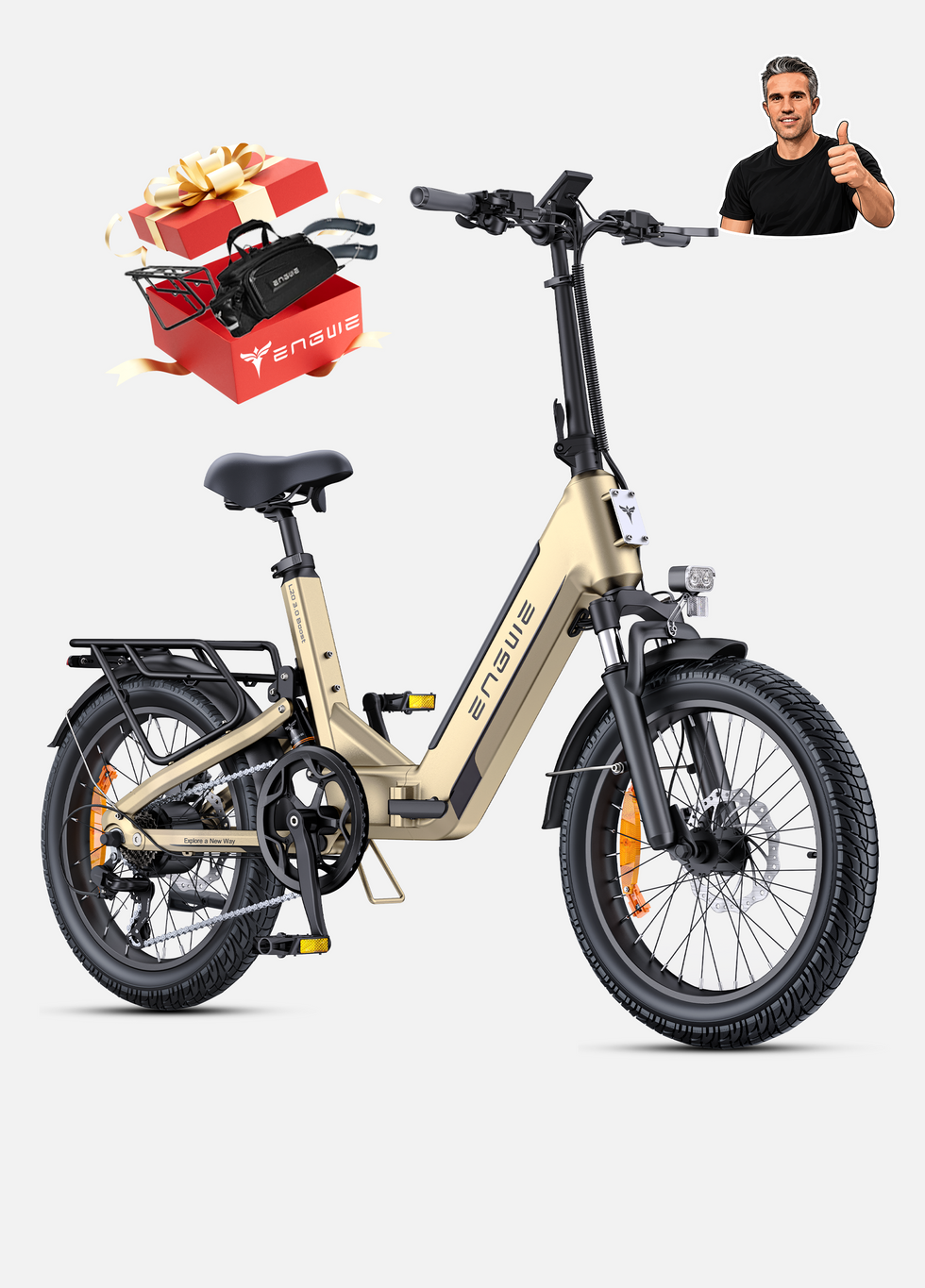
The ENGWE O20 Boost bike is meant for people who may require more mileage in order to make their commute on a daily basis. This is thanks to its LG battery of 720Wh that offers real-world mileage of 141km at PAS 1, 108km at PAS 3, and 80km at PAS 5, thus providing users with many options to choose from based on different levels of assistance.

ENGWE L20 3.0 Pro
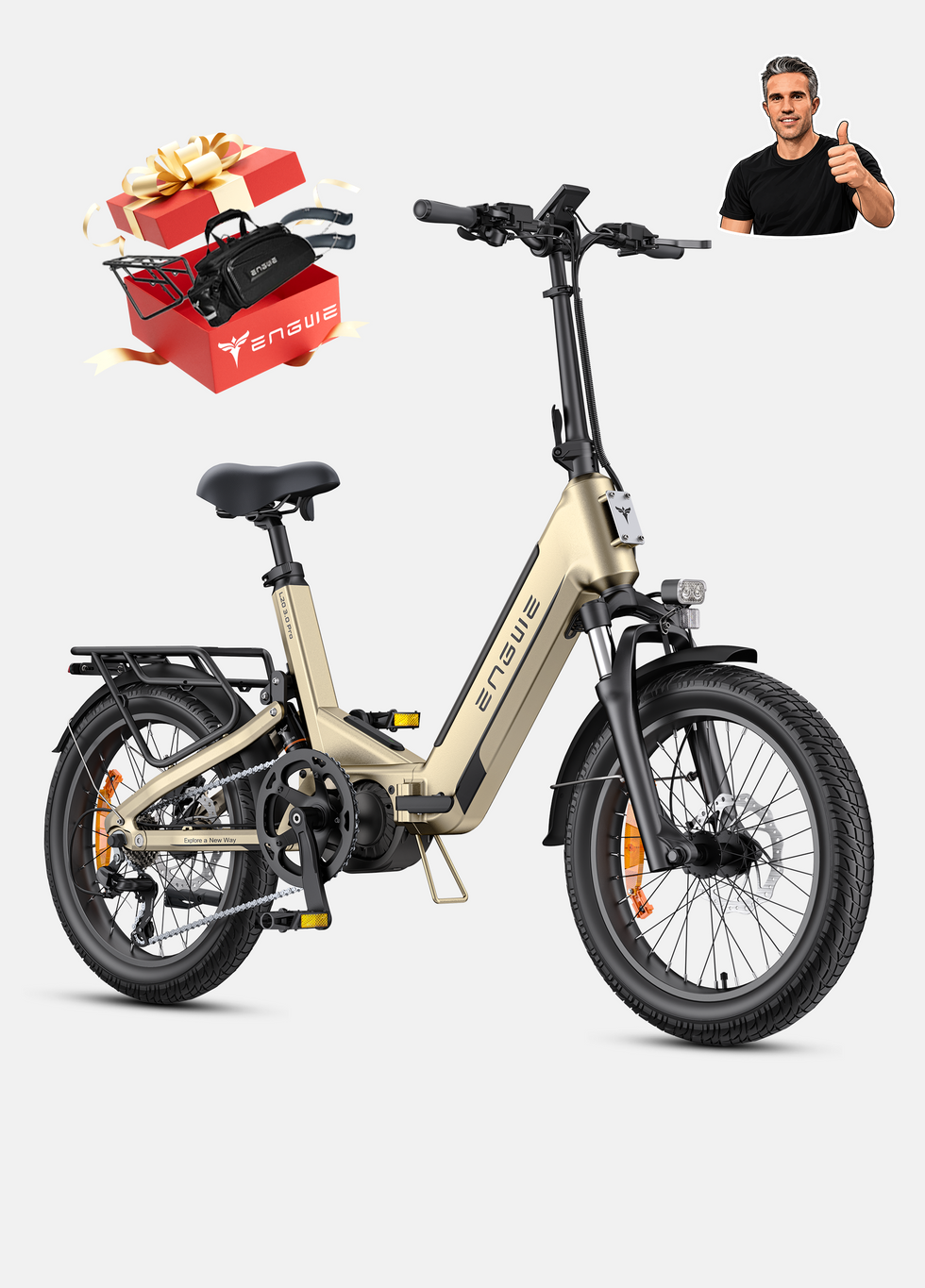
The ENGWE L20 3.0 Pro offers yet another choice for people who commute for longer distances or those who do not charge their bikes too often. This bike comes with a 720Wh removable battery that allows you to get up to 160km at once, thus covering a greater distance in your everyday commutes. An 8A fast-charging system also supports quicker battery replenishment, which can be useful when the e-bike is used regularly throughout the week.

CUBE Fold Hybrid 540
The CUBE Fold Hybrid 540 has a 20-inch wheel, giving riders who desire full-sized practicality in a foldable model the ability to do so. The foldable frame helps save space when storing or transporting the bicycle. At the same time, the use of a 20-inch wheel means that it is still pertinent to the discussion when compared to the larger wheels. It demonstrates how a folding electric bike can prioritise everyday city riding without relying on a smaller 16-inch wheel format.
UTO PRO16
UTO PRO16 is an example of a small-wheel model that is represented by a 16-inch folding bicycle. The folding size and the relatively light weight of the bike are its main distinguishing features, which make it especially suitable for situations where storage and convenience are important issues. It serves as a kind of outside benchmark that demonstrates how the 16-inch bicycle can be used with electric support.
Does Charging at Work Change How Much Range You Need?
Yes. Availability of a power supply at work changes everything since the battery now doesn’t have to make the whole journey in one charge. The person travelling 15 km both ways in a day has a new equation now if he is able to recharge his battery during the day at work.
Nevertheless, you should only include workplace charging in your range calculation if you are sure that there is a feasible and legal place to charge. Otherwise, the commute trip must be treated as a round-trip journey.
In a commuter e-bike, charging convenience may thus be just as important as range. It's not just about how far the bike will go, but also how convenient it will be to charge it on a regular basis.

When Does a Long Range Electric Bike Make Sense for Commuting?
The need for a long range electric bike is greater when the distance travelled on a day-to-day basis grows, charging possibilities become scarce, or when the bicycle itself serves other purposes apart from commuting.
Longer range also allows for greater flexibility in case one does not want to charge every time he rides. A commuter who travels daily without charging is different from someone who recharges every night.
Range should continue to match the reality of usage. Selecting an unnecessarily large range value just because it is there is less useful than determining weekly distance travelled, usage frequency, and the nature of the usual route.
How Do Hills and Rider Load Change Commuting Range?
Climbing typically involves greater expenditure of energy by the engine compared to covering the same distance while cycling in easier conditions. A commuting trip involving several inclines would thus require different battery capacity than one taken over flat surfaces.
Weight of the rider, cargo being transported, and other loads also add to the total mass that the bicycle must propel. The level of assistance is another factor; increased motor support leads to higher energy usage.
These factors account for why two cyclists travelling the same distance would experience varying ebike range. Conditions of the route should also be taken into account besides distance for commuting purposes.

Should You Choose Range Based on Daily or Weekly Riding?
Distance per day would be a good place to start since it shows the shortest distance that the bike would need to travel. After this, think about how often you would like to recharge your bike.
If you are satisfied with charging your vehicle at the end of each day's journey, then the battery capacity will only need to cope with the return journey on a daily basis. Otherwise, if you want to go several days without recharging, then this will increase the energy requirement.
Range considerations for days and weeks may prove helpful in differentiating between range that is essential and range that offers extra charging options.
What Should You Check Before Choosing a Commuter E-Bike?
Begin with the full-day distance travelled, including the return leg and any additional stops that are made. Consider factors such as gradients, assistance, rider and cargo weight, and charging availability.
The next step is to compare the power supply capacities and range claims by the manufacturers, keeping in mind that the maximums are simply guidelines and not assurances for each ride. In the case of the folding electric bike, the folded size and weight become important considerations too.
Consequently, an ideal electric bike for commuting is not one that has the biggest range figure. It is the one whose range, charging process, and design match the distance the cyclist has to cover on a regular basis.

Frequently Asked Questions
How much e-bike range do I need for commuting?
How much e-bike range do I need for commuting?
Compute your daily return range in full and make provision for riding changes. Hills, level of help, cargo weight, weather, and charging facilities can affect the proper range needed.
Is 60km of range enough for commuting?
Is 60km of range enough for commuting?
It could be if your usual round-trip mileage fits within that range for you under your usual riding conditions. What matters is how your range compares to the amount of miles you actually travel each day.
Do I need a long range electric bike for a short commute?
Do I need a long range electric bike for a short commute?
This may not be so. Shorter commutes may demand less range from a battery, especially if there is easy access to charging stations. The greater the distance to be travelled, the more important range becomes.
Does a folding electric bike have enough range for daily commuting?
Does a folding electric bike have enough range for daily commuting?
Yes, it can. The folding e-bike design doesn’t determine the range directly. It is affected by the battery capacity, motor configuration, level of assistance provided, and the condition of riding.
Should I charge my commuter e-bike every day?
Should I charge my commuter e-bike every day?
This will depend on the daily distance covered, battery size, and charging instructions from the manufacturer. Some commutes might take advantage of just a portion of the battery's capacity per day, while others will have to charge more often.